Posts

Life Cycles of Typical Stars

Image
The stages of evolution of a star largely depend on its  initial mass , the mass which it started with. Based on this stars are divided into 3 categories : the  low mass stars, the medium mass stars and the heavy ones . Low mass stars  have a mass of about  less than 0.8 times the mass of the Sun.  Since they are less massive, the gravitational pressure at their cores is low, making their fusion really slow. So such stars can undergo fusion for a really long time, which is estimated at around  10 trillion years . These stars are commonly referred to as red dwarf stars and have a low surface temperature, due to low fusion. Medium massed stars , like our Sun, have a mass from  0.8 to 10 times the mass of the Sun . These stars have a higher fusion rate as compared to low mass stars. When these stars run out of hydrogen to fuse, they look for the next best thing to fuse, Helium. Helium fusion occurs in the following steps Calculating the energy...

A binary star to the SUN ?!

Image
A less likely possibility. An upper limit of distance between two binary stars is around o.25 light years. Considering that and the fact that we are able to observe stars and celestial objects with apparent magnitudes up to 32, we get using the expression… (where m = apparent magnitude i.e., 32 in this case, M = absolute magnitude, r is distance in parsecs ) M ≈ 42.57 This value is so high ( meaning that the star is too dim ). In fact the dimmest red dwarfs ever observed, are only about 15 - 20 in absolute magnitude. If we still want to theoretically prove it wrong, we can go ahead and use the Stefan- Boltzmann Law to make an attempt to find its surface temperature. Assuming a Sun sized binary star, with an area of 6.09 * 10 ^18 m^2, plugging in some values we get T, the surface temperature of the binary star to be a mere 1.02 Kelvin. If we try to make the size of the binary star even smaller, ( in an attempt to increase the surface temperature) by pushing it ...

Oumuamua, the interstellar asteroid ( or is it ? )

Image
Discovered by the Pan-Starrs telescope in October 2017, this rocky body has been claimed to be the  first interstellar body  to enter the solar system. It is interstellar in the sense it came from a different star system. This was determined by studying its orbit, and its chemical composition. It was found to have a higher velocity ( around 320,000 kilometres per hour ) than it would have if it orbited the Sun, hence it must have been from somewhere else. ( Of course, the below image is a piece of an artist’s imagination of how it would look like ). The asteroid was also weirdly shaped like an elongated cigar, which drew media attention, who hypothesised that it could be an alien spaceship. After some debate, a paper was published in March 2018 which said that Oumuamua was in fact, a comet and not an interstellar asteroid as it was previously claimed. This was established with some evidence relating to its trajectory through the Solar System. It was expected to go ...

Download any pdf for FREE

I just discovered a hack that would allow you to download any PDF file from the internet FOR FREE! It is really basic and easy to do yourself. Source code <html> <body> <a href="your link for the pdf goes here" download> Click </a> </body> </html> See, it's pretty simple !

Galaxies #2 - Elliptical Galaxies

Image
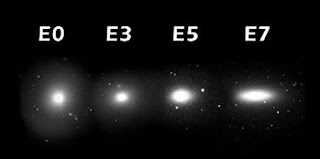
Elliptical galaxies, like the name suggests have an elliptical shape with no specific axis of rotation. Elliptical galaxies are classified on the basis of their eccentricity, ie how much they deviate from a circle. The class starts from E0 which are the most circular galaxies to E7 which are the most elliptical in shape. Elliptical galaxies are also divided into stages. Compact elliptical galaxies are denoted by cE, normal ellipses just by E and late elliptical galaxies by E+. For example the galaxy M32, located in the constellation Andromeda is denoted cE2. It looks like this. It is clearly seen that it is only slightly elliptical and hence denoted by 2. Another elliptical galaxy is M59 which is more elliptical than M32 and hence designated as E5. It looks like this.

Galaxies #1 - Spiral Galaxies

Image
Galaxies are mainly of three types - Spiral, Elliptical and Irregular. They are subdivided into classes and designated a specific type. Spiral Galaxies :  They have three main features namely a bulge , a halo and a disc . The bulge is the central portion of the spiral which is significantly brighter than the rest of the galaxy. The bulge of most galaxies is known to contain a super massive black hole (SMBH) in it. The disc consists of the spiral arms around the bulge. The halo is a faint enclosure around the galaxy. The halo mainly contains globular clusters which contain old stars. Spiral galaxies are categorised into two varieties. The spiral galaxies, whose arms extend right from the bulge are termed as ordinary spiral galaxies and designated as SA. On the other hand, some spiral galaxies have spiral arms which don't extend from the bulge, but extend from an elongation of the bulge. Theses galaxies are known as Barred Spiral Galaxies and are designated as SB.  T...

Spherical Geometry #4 - Longitudes

Image
Longitudes of the Earth are great spheres passing through the North Pole and the South Pole of the Earth.In the figure shown all the blue lines going from the top to the bottom are longitudes. Longitude is measured as the angular distance east or west between the great circle (or meridian) of the point and the Greenwich Meridian.  It can be measured in degrees as well as hours. It is more convenient to calculate longitude in hours because the time difference between two points on the Earth can be measured easily. Since the Earth takes 24 h to spin around itself once and also that a sphere has to rotate 360° to return to its original configuration, 24 h is equivalent to 360°. So 1 h is equivalent to 15° of the globe.

Acobot Widget