Posts

Oumuamua, the interstellar asteroid ( or is it ? )

Image
Discovered by the Pan-Starrs telescope in October 2017, this rocky body has been claimed to be the  first interstellar body  to enter the solar system. It is interstellar in the sense it came from a different star system. This was determined by studying its orbit, and its chemical composition. It was found to have a higher velocity ( around 320,000 kilometres per hour ) than it would have if it orbited the Sun, hence it must have been from somewhere else. ( Of course, the below image is a piece of an artist’s imagination of how it would look like ). The asteroid was also weirdly shaped like an elongated cigar, which drew media attention, who hypothesised that it could be an alien spaceship. After some debate, a paper was published in March 2018 which said that Oumuamua was in fact, a comet and not an interstellar asteroid as it was previously claimed. This was established with some evidence relating to its trajectory through the Solar System. It was expected to go ...
Download any pdf for FREE

I just discovered a hack that would allow you to download any PDF file from the internet FOR FREE! It is really basic and easy to do yourself. Source code <html> <body> <a href="your link for the pdf goes here" download> Click </a> </body> </html> See, it's pretty simple !

Galaxies #2 - Elliptical Galaxies

Image
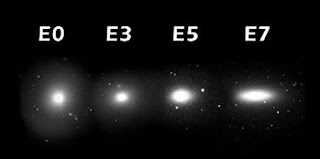
Elliptical galaxies, like the name suggests have an elliptical shape with no specific axis of rotation. Elliptical galaxies are classified on the basis of their eccentricity, ie how much they deviate from a circle. The class starts from E0 which are the most circular galaxies to E7 which are the most elliptical in shape. Elliptical galaxies are also divided into stages. Compact elliptical galaxies are denoted by cE, normal ellipses just by E and late elliptical galaxies by E+. For example the galaxy M32, located in the constellation Andromeda is denoted cE2. It looks like this. It is clearly seen that it is only slightly elliptical and hence denoted by 2. Another elliptical galaxy is M59 which is more elliptical than M32 and hence designated as E5. It looks like this.

Galaxies #1 - Spiral Galaxies

Image
Galaxies are mainly of three types - Spiral, Elliptical and Irregular. They are subdivided into classes and designated a specific type. Spiral Galaxies :  They have three main features namely a bulge , a halo and a disc . The bulge is the central portion of the spiral which is significantly brighter than the rest of the galaxy. The bulge of most galaxies is known to contain a super massive black hole (SMBH) in it. The disc consists of the spiral arms around the bulge. The halo is a faint enclosure around the galaxy. The halo mainly contains globular clusters which contain old stars. Spiral galaxies are categorised into two varieties. The spiral galaxies, whose arms extend right from the bulge are termed as ordinary spiral galaxies and designated as SA. On the other hand, some spiral galaxies have spiral arms which don't extend from the bulge, but extend from an elongation of the bulge. Theses galaxies are known as Barred Spiral Galaxies and are designated as SB.  T...

Spherical Geometry #4 - Longitudes

Image
Longitudes of the Earth are great spheres passing through the North Pole and the South Pole of the Earth.In the figure shown all the blue lines going from the top to the bottom are longitudes. Longitude is measured as the angular distance east or west between the great circle (or meridian) of the point and the Greenwich Meridian.  It can be measured in degrees as well as hours. It is more convenient to calculate longitude in hours because the time difference between two points on the Earth can be measured easily. Since the Earth takes 24 h to spin around itself once and also that a sphere has to rotate 360° to return to its original configuration, 24 h is equivalent to 360°. So 1 h is equivalent to 15° of the globe.

Spherical Geometry #3 - Latitudes

Image
The latitudes of the Earth are small circles except the Equator. We consider the Earth to be a perfect sphere for simplicity. We define the latitude  (Φ)   of a point as the angle which between the point, the centre of the sphere, and the corresponding point in the great circle directly below it. In the diagram shown, the latitude of a point B is the angle BOD. Latitude is measured in degrees, arc minutes and arc seconds north or south from the Equator. It is obvious that the latitude of the Equator is 0° and that of the North/South pole is 90° N/S.  Another useful term related to latitude is the colatitude. The colatitude is angle from the pole to the centre to the point. In other words, colatitude is the complementary angle of the latitude. In the diagram the colatitude of B is the angle POB. So POB = 90° - DOB.  Hope that was useful...

Spherical Geometry #2 - Spherical triangles and angles

Image
So what's a spherical triangle ? We know that a normal triangle lies on a plane. Spherical triangles, on the other hand, lie on a sphere. The sides of a spherical triangle lie on great circles. The triangle ABC in the figure shown is a spherical triangle. Spherical angles:  The angles of the spherical triangle, ie, spherical angles are defined as follows.  Consider two sides of the triangle. Draw tangents at the meeting point of the two sides in the plane of the two sides. The angle between the tangents is called the angle between the two sides. Properties of a spherical triangle : 1. Unlike a normal triangle, the angles of a spherical triangle don't add up to 180°. In fact the sum of the angles of a triangle always adds up to more than 180° but is always less than 540° . 2. So each angle of a spherical triangle is always less than 180°. 3. Sum of any two sides of the triangle is always greater than the third side. More posts coming soon....

Acobot Widget